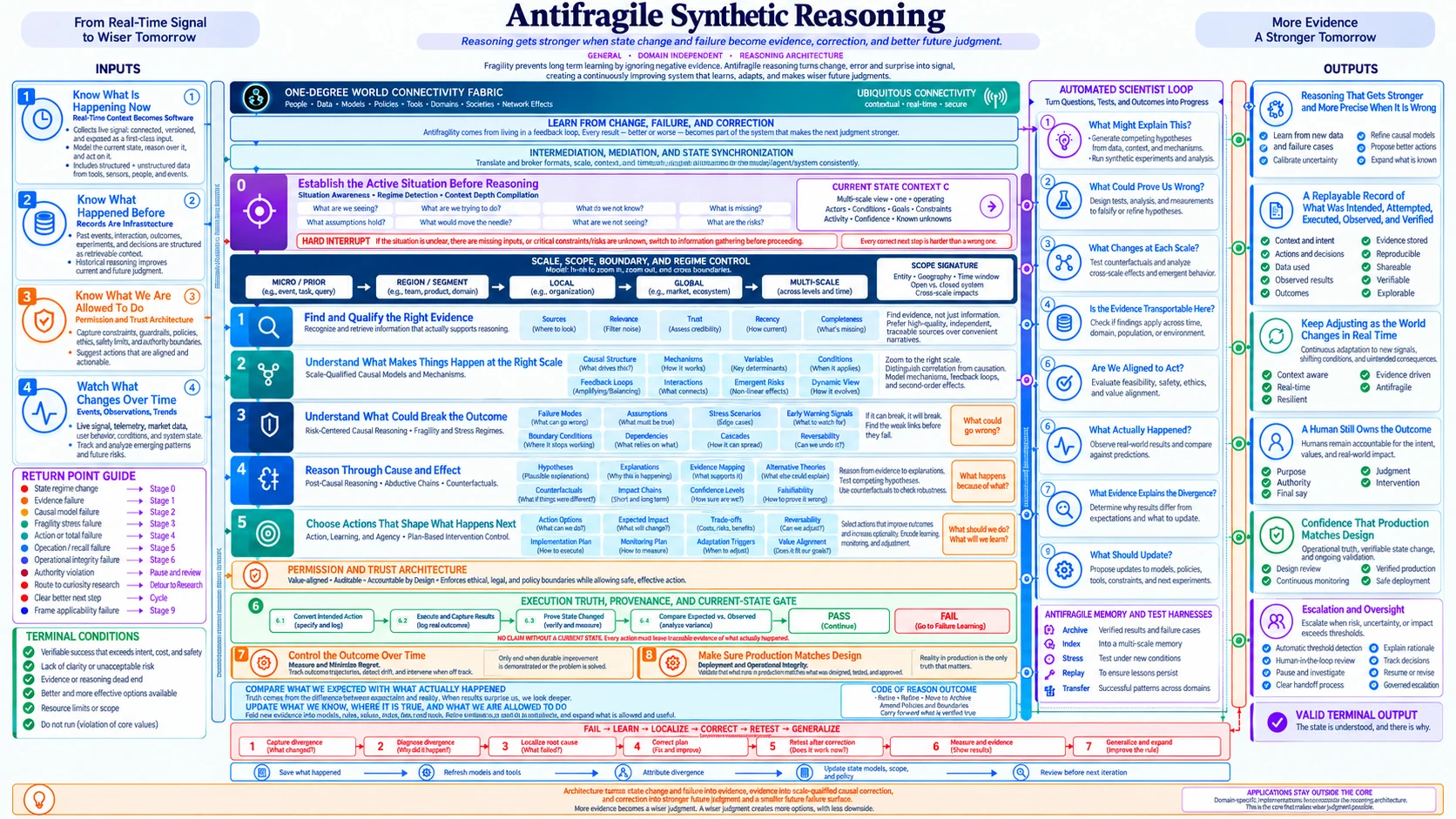
Page 1
Executive Overview
Use it to orient the decision, not to do the detailed work.
Stage crosswalk Page 1 = overview (all stages)
Use this page whenAt the beginning of a decision, at the beginning of a workshop, or whenever people are solving different parts of the problem without realizing it.
ObjectiveLocate the work in the architecture. Identify what is already known, what stage is active, which outputs already exist, and which stage should own the next question.
Questions to force- Where are we in the reasoning lifecycle right now?
- Which earlier stage has already produced a trustworthy output?
- Which stage is being skipped because it feels inconvenient?
- Are we treating an evidence problem as an action problem, or a causal problem as an evidence problem?
- Where would a failure send us back?
Required outputA one-sentence stage declaration: “We are at Page X because Y is established, Z is still unresolved, and the next required output is ____.”
Advance only whenEveryone can explain why the current stage is the right stage and what the next stage requires.
Loop back whenThe group is arguing across stages. For example, one person is proposing actions while another is still disputing the facts.
Page 2
Inputs, Context, and Starting Conditions
Establish the situation before the system is allowed to reason forward.
Stage crosswalk Page 2 = Stage 0 (establish the active situation)
Use this page whenA new problem arrives, the operating environment changes, a previous conclusion is being reopened, or the team is not confident that it is looking at the same situation.
ObjectiveTurn raw inputs into a shared current-state model. Separate what is happening now, what happened before, what is allowed, and what is changing over time.
Questions to force- What are we seeing now?
- What do we know, and what do we not know?
- Which assumptions are carrying the conclusion?
- What regime are we in: normal, stressed, crisis, transition, or novel?
- What is inside and outside the boundary?
- What could matter that we are not currently seeing?
- What is prohibited, constrained, or requires human authority?
Required outputA structured situation summary with current state, known facts, unknowns, assumptions, regime, boundaries, constraints, and material risks/opportunities.
Advance only whenThe active situation is clear enough that evidence can be sought against a specific question, scope, and time horizon.
Loop back whenNew information changes the regime; assumptions fail; context is stale; key inputs are missing; or the situation cannot be described without argument.
Page 3
Scale, Scope, and Evidence
Define where to look and what deserves to count as evidence.
Stage crosswalk Page 3 = scale/scope/boundary/regime control + Stage 1 (find and qualify evidence)
Use this page whenThe question is clear enough to investigate, but evidence is scattered, inconsistent, noisy, or comes from different levels of the system.
ObjectiveSet scale, scope, boundary, and regime first. Then find evidence that is relevant, trustworthy, current, complete enough, and appropriate to the question.
Questions to force- At what scale does the question actually live?
- Could the same signal mean something different at another scale or under another regime?
- What is explicitly out of scope?
- Which sources are independent, traceable, and close to the phenomenon?
- What contradicts our preferred evidence?
- How current must evidence be?
- What is missing, and how much does the missing evidence matter?
- Is the evidence transportable from its original context to this one?
Required outputAn evidence ledger: source, claim supported, scale, recency, credibility, contradictions, uncertainty, missing evidence, and applicability to the current regime.
Advance only whenThe evidence set is good enough to support causal work, and the team can explain both what the evidence says and what it does not justify.
Loop back whenThe evidence changes, contradictions are unresolved, important sources are missing, or the scope has shifted enough to make the existing evidence incomparable.
Page 4
Causal Structure and Mechanisms
Move from correlation to an explanation that can survive scale changes.
Stage crosswalk Page 4 = Stage 2 (causal structure and mechanisms)
Use this page whenYou have qualified evidence and need to explain what actually produces the outcome, not merely what moves with it.
ObjectiveBuild a causal model with variables, mechanisms, conditions, interactions, feedback loops, emergent risks, and dynamics. Qualify the model by scale.
Questions to force- What is a cause, what is a mechanism, and what is an outcome?
- Which variables are direct causes, indirect causes, mediators, or merely correlated?
- Under what conditions does the mechanism operate?
- What feedback loops amplify or stabilize the system?
- What changes when we move from micro to local to global to multi-scale?
- Where are delays, nonlinearities, thresholds, or tipping points?
- What new risk emerges from interactions that is not visible in the parts alone?
Required outputA causal map or mechanism model that names the important variables, relationships, conditions, feedbacks, time dynamics, and scale boundaries.
Advance only whenThe team can explain how change propagates from cause to outcome and can identify where an intervention would plausibly change the result.
Loop back whenThe model depends on unexplained correlation, contains a black-box mechanism, fails at another relevant scale, or cannot explain important observed behavior.
Page 5
Fragility, Risk, and Cause-and-Effect Reasoning
Try to break the model before reality does.
Stage crosswalk Page 5 = Stages 3 and 4 (what could break the outcome; cause and effect)
Use this page whenA causal story exists, but before acting you need to know how it can fail and whether another explanation fits the evidence as well or better.
ObjectiveStress-test the causal model and reason through competing explanations. The goal is not to defend the first plausible story. The goal is to find the explanation that survives evidence, counterfactuals, and failure analysis.
Questions to force- What failure modes could invalidate the outcome?
- What must be true for this conclusion to hold?
- What changes under severe but plausible stress?
- What would we see before failure becomes obvious?
- Which dependencies could cascade?
- Can the action or outcome be reversed?
- What other hypotheses explain the same evidence?
- What evidence supports and contradicts each hypothesis?
- What counterfactual would materially change the conclusion?
- What would falsify the preferred explanation?
Required outputA fragility and explanation record containing failure modes, boundary conditions, early-warning signals, dependencies, competing hypotheses, counterfactuals, confidence, and falsifiers.
Advance only whenThe preferred explanation has survived serious alternatives and the team knows what evidence would lower its confidence or overturn it.
Loop back whenA plausible failure mode is unmanaged, an alternative explanation fits equally well, confidence is being asserted without falsifiability, or the evidence cannot distinguish among hypotheses.
Page 6
Action, Agency, and Trust
Turn understanding into authorized, monitored, reversible action.
Stage crosswalk Page 6 = Stage 5 (choose actions) + permission and trust architecture
Use this page whenThe evidence and causal reasoning are strong enough to justify intervention, and the next question is what to do.
ObjectiveGenerate options, compare impact and trade-offs, choose an action, define implementation and monitoring, and ensure the action sits inside explicit permission and trust boundaries.
Questions to force- What can we do now?
- What is the expected effect and over what time horizon?
- What trade-offs, side effects, and opportunity costs come with each option?
- How reversible is the action?
- What will we monitor?
- What condition would trigger adaptation, pause, or reversal?
- Who is authorized to approve or execute it?
- Does the action fit legal, ethical, safety, policy, and human-value constraints?
- What will we learn even if the action fails?
Required outputAn authorized action record: selected option, expected impact, rationale, trade-offs, owner, permissions, implementation plan, monitoring plan, thresholds, reversal path, and learning objective.
Advance only whenThe action is feasible, authorized, monitorable, sufficiently reversible for its risk, aligned with values and policy, and designed to generate useful evidence.
Loop back whenAuthority is unclear; constraints are violated; no one owns the outcome; monitoring is missing; or the action is too irreversible for the confidence level.
Page 7
Execution, Verification, and Learning from Outcomes
Reality is the gate. No claim survives without evidence of what actually happened.
Stage crosswalk Page 7 = Stages 6, 7, 8 (6 execution truth/provenance/current-state gate, 7 control the outcome over time, 8 production matches design) + compare expected with actual
Use this page whenAn action has been approved and execution is beginning, or a result has occurred and must be verified before anyone claims success or failure.
ObjectiveCapture provenance, verify state change, control the outcome over time, make sure production matches design, compare expected with actual, and decide what must update.
Questions to force- What exactly was executed, by whom, when, where, and under what version/configuration?
- Did the state actually change?
- What metrics show the real outcome?
- Where did observed behavior diverge from expectation?
- Is the divergence noise, execution error, model error, regime change, or a new mechanism?
- Does production match what was designed and tested?
- Should we continue, adjust, retry, stop, or escalate?
- What model, policy, permission, or memory must change now?
Required outputA replayable execution record with provenance, verified current state, outcome metrics, expected-versus-actual variance, root-cause attribution, production validation, and update decision.
Advance only whenThe state change is verified, the result is explainable, the production system matches the intended design, and the next action or terminal state is justified by evidence.
Loop back whenThe current state cannot be verified; production differs from design; metrics conflict; the result surprises the model; or the variance cannot yet be localized.
Page 8
Automated Scientist Loop and System Outputs
Use experimentation, memory, and test harnesses to compound learning safely.
Stage crosswalk Page 8 = automated scientist loop, memory and test harnesses (cross-cutting)
Use this page whenThroughout the process when a claim can be tested, and at the end of a cycle when results should update memory, models, policies, or future experiments.
ObjectiveTurn questions into hypotheses, falsification tests, measurable predictions, evidence-quality checks, updates, and observed outcomes. Preserve what was learned and prove that improvements do not create regressions.
Questions to force- What might explain this?
- What could prove us wrong?
- What measurable prediction follows if the hypothesis is true?
- Is the evidence trustworthy in this context?
- What should update if the result holds?
- What actually happened?
- Can the result be replayed and reproduced?
- Does the proposed improvement pass regression, safety, alignment, and policy tests?
- What learning should transfer to another domain, scale, or future decision?
Required outputA scientist-loop record plus durable memory: hypotheses, tests, predictions, observations, updates, test-harness results, reusable lessons, and a verified terminal output.
Advance only whenThe result is usable, verifiable, reproducible enough for its risk, safely incorporated into memory or policy, and remains reviewable by humans.
Loop back whenThe result cannot be reproduced, the update causes regressions, the evidence is not transportable, the system cannot explain what changed, or human accountability is unclear.
Operating practice
How to use the pages in real work
The framework can be used three ways: as a human decision-room method, as an AI or agent orchestration pattern, or as a hybrid in which machines carry evidence and reasoning work while humans retain authority for consequential outcomes.
Human workshopUse one page at a time as the meeting agenda. Assign a decision owner, evidence owner, red-team role, and recorder. Keep Page 1 visible as the map. Record the required output before moving forward.
AI / agent workflowMap each page to an explicit state, prompt, tool set, memory object, and transition gate. The agent is not allowed to advance when the stage output or confidence criteria are missing.
Hybrid operating modelLet the system retrieve, compare, model, simulate, and maintain provenance. Reserve approval, value judgments, authority changes, exceptions, and consequential intervention for accountable humans.
When to slow down
When to slow down
The higher the consequence, irreversibility, uncertainty, novelty, or cross-scale impact, the more rigor the framework should demand. Low-consequence work can use a light pass. High-consequence work should preserve full evidence, provenance, alternatives, permissions, tests, and review.
Reasoning receipts
The minimum artifacts the framework should leave behind
The architecture becomes operational when every major step leaves a durable reasoning receipt. These are not paperwork for its own sake. They are the evidence that allows the next stage, a reviewer, or a future system to understand why the decision was made and what would change it.
| Artifact | Source | Minimum contents |
|---|
| Situation brief | Page 2 | Current state, regime, boundaries, assumptions, unknowns, constraints, time horizon. |
| Evidence ledger | Page 3 | Source, claim, scale, recency, trust, contradictions, uncertainty, applicability, missing evidence. |
| Causal model | Page 4 | Variables, mechanisms, conditions, interactions, feedback loops, dynamics, scale limits. |
| Fragility + hypothesis record | Page 5 | Failure modes, dependencies, early warnings, alternatives, counterfactuals, confidence, falsifiers. |
| Action and authority record | Page 6 | Option, expected impact, trade-offs, reversibility, permissions, owner, monitoring, adaptation triggers. |
| Execution and variance record | Page 7 | What was executed, provenance, verified state, expected vs actual, root cause, production integrity, update decision. |
| Experiment + memory record | Page 8 | Hypotheses, tests, predictions, observations, updates, regressions, reusable learning, terminal status. |
The final discipline
The final discipline
The purpose of the framework is not to make reasoning look rigorous. It is to make reasoning correctable. Every important claim should have evidence. Every causal story should have a failure surface. Every action should have authority and a monitoring plan. Every execution should leave provenance. Every surprise should update what the system knows. And every consequential outcome should remain owned by a human.
Know the state. Qualify the evidence. Explain the cause. Try to break the explanation. Act within authority. Verify reality. Learn from the difference.