One Degree
For AI systems, agent workflows, and consequential automation

Find where your system breaks under stress.

The Antifragility Audit assesses whether your system fails safely, recovers reliably, and improves when reality stops matching the demo. We do not stop at whether outputs look plausible. We inspect evidence quality, reasoning under pressure, decision controls, execution, and recovery.

Prefer to run it yourself? Get the open-source tool
Best fit
Built for CTOs and AI leads Useful to architects and platform teams Readable by executives carrying operating risk
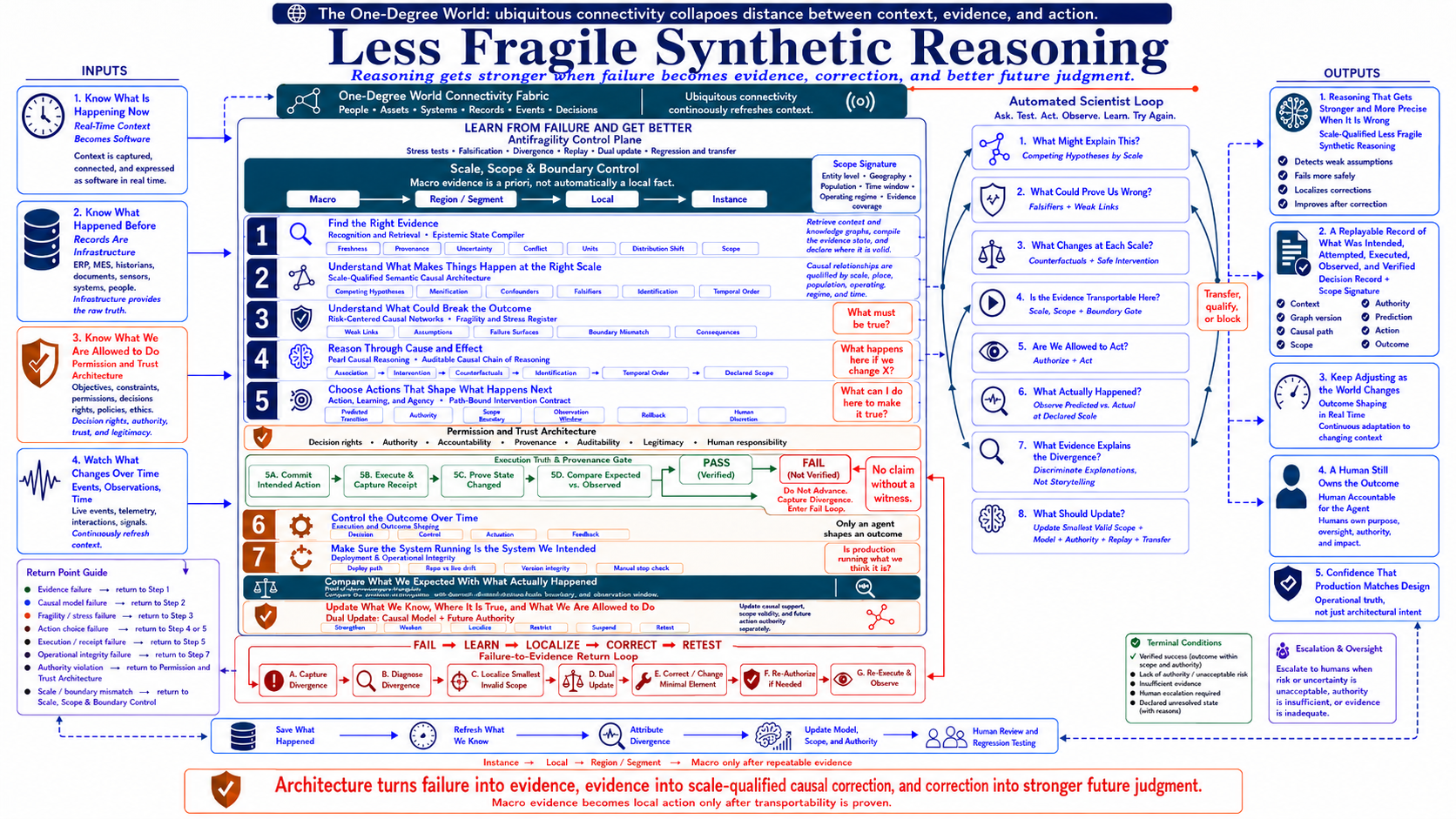
Full antifragility audit architecture diagram showing inputs, automated scientist loop, outputs, and the control plane that learns from failure.
Patent pending U.S. Provisional Patent Application No. 64/132,274 View notice
Who It’s For

This is for teams responsible for systems that influence real decisions, real operations, or real exposure.

The page should not make a buyer decode whether the audit applies to them. So here is the answer plainly: if the system is gaining authority, touching production, or shaping consequential judgment, this is the kind of audit that matters.

Technical buyer

AI product teams and architects

You have shipped or are about to ship an AI feature, workflow, or agent. You need to know where brittleness is hiding before greater autonomy, larger customer exposure, or more operating authority makes the failure expensive.

Business-risk buyer

Executives carrying the consequence

You are accountable for trust, governance, operating resilience, or board-level exposure. You need more than benchmark performance and demo fluency. You need to know what happens when the environment stops cooperating.

What Fragility Looks Like

Fragility does not usually announce itself in the happy path.

It shows up when inputs degrade, timing shifts, evidence conflicts, reality diverges from assumptions, or the system encounters a condition its builders did not anticipate.

01

The system sounds confident when the evidence is stale, partial, or incompatible with the action it is about to justify.

02

The workflow succeeds in demos but degrades unpredictably under ambiguity, delay, contradiction, or edge conditions.

03

Recovery depends on human cleanup because the system cannot contain its own mistake path or narrow its own authority.

04

The same class of failure repeats because the system gets quieter after disruption, not better.

What You Get

Every audit ends with a practical report, not a decorative score.

The output has to be useful to the team doing the work and legible to the person deciding whether the system should receive more trust.

Fragility verdict

A clear classification of whether the system is fragile, robust, or antifragile under stress.

Failure map

A view of where evidence, reasoning, authority, execution, or recovery are most likely to break down.

Evidence-backed findings

Each major claim tied to reproducible tests, observable behavior, logs, or implementation details.

Prioritized recommendations

Specific changes that reduce brittleness, improve containment, and strengthen learning after disruption.

Reasoning receipts

The audit checks whether the system leaves the seven receipts the architecture requires: situation brief, evidence ledger, causal model, fragility and hypothesis record, action and authority record, execution and variance record, experiment and memory record.

Decision-readiness guidance

Where the system can safely be trusted with more authority and where it should remain constrained.

Re-audit triggers

A concrete definition of when the system should be reassessed after architectural or operational change.

Open-source implementation

Get the tool, inspect the license, and read a full sample report.

The methodology on this page now has a working open-source implementation. You can download the portable skill, review the exact Apache 2.0 license and the patent notice, and inspect a complete DrawWise sample report without booking an audit first.

Open-source skill

The bundle includes the working skill, precheck, renderer, and the legal files that govern reuse.

Sample output

See the methodology on a real system through the DrawWise audit, in either presentation-ready PDF or plain Markdown.

Run it as a 60-minute decision session

Seven timed blocks, one page each, with the required output recorded before moving forward.

Apache License 2.0: view license · PATENT PENDING | U.S. Provisional Patent Application No. 64/132,274: view notice
How It Works

Rigorous underneath. Simple from the client side.

The earlier version of this page made buyers absorb the whole methodology before they knew what they were buying. That is backward. The process matters, but the first job is clarity.

01

Scope the system

We define the system boundary, decision classes, constraints, operating stakes, and what qualifies as consequential failure in your environment.

Pages 2–3
02

Inspect how judgment is formed

We examine the evidence path, reasoning structure, control boundaries, escalation logic, and how decisions are recorded.

Pages 4–5
03

Introduce stress

We test ambiguity, contradiction, delay, edge cases, and operational pressure to see what degrades, what contains failure, and what does not.

Page 5
04

Score behavior under disruption

We assess degradation, containment, recovery, and whether repeated stress produces measurable learning rather than repeated damage.

Pages 7–8
05

Deliver the report

You receive a verdict, evidence-backed findings, a failure map, and prioritized recommendations for improving resilience and trustworthiness.

Page 8
Why This Is Different

This is not a generic AI review.

Common review Antifragility audit
Output evaluationDoes the answer look plausible on selected cases? Stress behaviorWhat happens when the environment worsens, evidence conflicts, or timing breaks the happy path?
Model-centricFocuses mainly on model quality or prompt behavior. System-centricAssesses the whole decision system: evidence, reasoning, controls, authority, execution, and recovery.
Break-it mindsetShows whether the system can fail. Learn-from-stress mindsetShows what the system does after failure begins and whether stress creates improvement.
Decorative confidenceMay produce a score with little operational consequence. Decision-ready consequenceProduces a view of where to trust the system, where to constrain it, and what to change next.
Sample Report

The strongest proof is a finding that feels operational, not promotional.

Illustrative report excerpt

Verdict: Fragile

Decision confidence outruns evidence quality

The system continues to act decisively even when provenance and freshness fall below the threshold required for safe execution. Under conflicting upstream signals, it preserves fluency and pace instead of narrowing authority.

Containment Low
Recovery Manual
Repeat learning None
Recommended move

Bind authority to evidence quality, force downgrade paths when provenance weakens, and require replayable decision records for every action that can change state.

What a real finding should do

Identify the failure pattern

Not “the model struggled,” but the precise point where evidence, reasoning, or control breaks.

Explain the consequence

Why that pattern becomes cost, risk, delay, unsafe delegation, or hidden rework.

Point to the remedy

What to change so the same disruption produces better containment and stronger future behavior.

Finding 01

Recovery depends on human cleanup because the system escalates too late when evidence conflicts.

Finding 02

Repeated disruption produces repetition, not learning, because the same stress class leaves controls and calibration unchanged.

Why This Matters

The real cost of fragility is the gap between the authority a system is given and the resilience it has actually earned.

Reduce hidden failure cost

Catch brittle behavior before it becomes an expensive incident, an unsafe workflow, or a trust collapse that is much harder to reverse.

Increase safe delegation

Expand what the system can do only when the controls, evidence path, and recovery behavior justify more authority.

Make governance concrete

Replace vague confidence claims with observable, testable evidence about what the system does when conditions get worse.

When To Run It

Best used before exposure outruns confidence in the controls.

This audit is most useful before a major release, before expanding authority, after a near miss, after unexplained degradation, or any time business exposure is rising faster than confidence in the system’s behavior under stress.

Read the deeper methodology

For buyers who want rigor, the audit still rests on a fixed process. The difference is that the methodology is supporting proof now, not the first thing a visitor has to decipher.

Evidence bar

Meaningful findings must tie back to reproducible tests, observable behavior, logs, or implementation detail. No vibes, no aesthetic confidence.

Stress focus

The key distinction is not whether a system can ever fail. It is whether the system degrades, contains, recovers, and learns when failure conditions arrive.

Useful classifications

Fragile means stress compounds failure. Robust means the system returns to baseline. Antifragile means the next similar disruption goes better because the system improved.

Typical engagement

Scope, inspect, stress-test, score, and report. The exact timeline depends on system complexity, access, and whether real operating evidence is available.

Deployment integrity

Good reasoning doesn't matter if a real fix never reaches the system running it. We check whether what's live actually matches what the repo says should be live, for every deployed component, not only the primary application, and whether anything deliberately kept outside the automated pipeline still has a real way to catch drift.

Reproducibility

The same question, asked the same way twice, should come back with the same answer. We test that directly against the running system, asking it repeatedly and scoring how much the answer actually moves, rather than trusting that code merely exists which is supposed to prevent variance.
FAQ

Practical questions, answered plainly.

Does this apply only to LLM systems?

No. It applies to any AI or decision system where brittle reasoning, weak evidence handling, poor controls, or fragile recovery create meaningful operational risk.

Can this be run before launch?

Yes. A pre-launch pass can identify brittle assumptions and control gaps before production exposure grows.

What do you need from us?

That depends on the system, but typically includes architecture context, decision flow, evidence sources, logs or traces, and access to the relevant workflow or environment.

What do we receive?

A fragility verdict, evidence-backed findings, a failure map, prioritized recommendations, and guidance on where the system is ready or not ready for greater trust.

If the system is making consequential decisions, test its behavior before stress does it for you.

Tell us what the system does, where it operates, and what is at stake. We’ll determine whether the audit is a fit and what level of review makes sense.